WhatsApp Business API in Brazil: Everything Developers Need to Know
May 22, 2026
·
18 min read
In this guide: Why Brazil is #1 · Brazilian WhatsApp culture (voice notes!) · LGPD compliance requirements · PT-BR template patterns · Pricing in BRL · PIX payment integration · hreflang for pt-BR · AWS São Paulo hosting · Opt-in requirements · SocialHook PT-BR setup
Why Brazil is WhatsApp's most important market
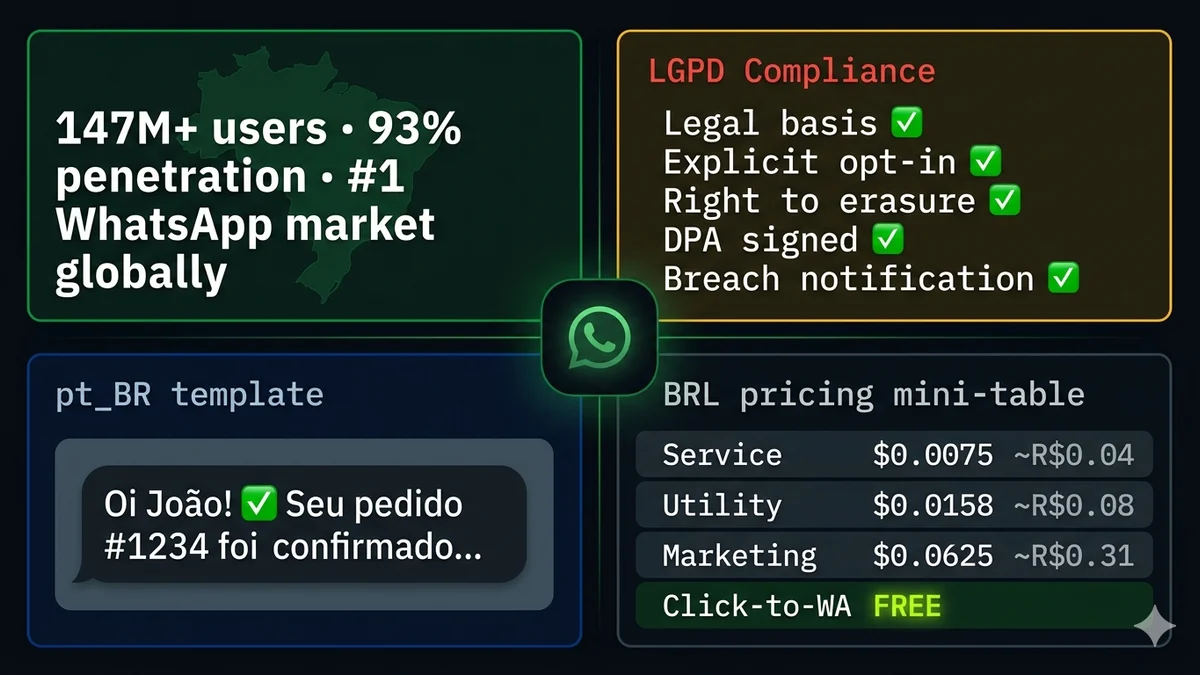
147M+
Active WhatsApp users in Brazil
93%
Smartphone penetration using WhatsApp
#1
Country where Meta launched WhatsApp Pay
79%
Brazilians prefer WhatsApp for business contact
Brazil is not just a big WhatsApp market — it is structurally different from every other market. WhatsApp in Brazil functions as the default communication layer for everything: customer service, sales, banking notifications, government services, order confirmations, scheduling, and social contact. Email in Brazil is for formal legal correspondence. SMS is for OTPs. WhatsApp is for everything else.
When you build a WhatsApp integration targeting Brazilian users, you are not building a supplementary channel — you are building the channel. The API must be correct from day one. LGPD compliance cannot be bolted on later. PT-BR template quality matters because users read every word. And voice notes are not an edge case — they are the primary way Brazilians communicate.
Brazilian WhatsApp culture: what developers must understand
Brazilian WhatsApp behavior differs from European and North American norms in several ways that directly impact how you architect your integration:
WhatsApp replaces all other channels. A Brazilian customer who contacts your company expects to do everything via WhatsApp — inquire, purchase, track order, request support, get a nota fiscal. If your bot can't handle all of this, they'll go to a competitor who can.
Response latency expectations are aggressive. Brazilian users expect replies within minutes, not hours. An AI agent that handles outside-hours inquiries instantly is not a luxury — it is a basic expectation that matches the communication culture.
Informal language is standard, even in business. Brazilian PT-BR business communication is considerably more informal than European Portuguese or even English. Using "você" over "tu," including diminutives, and using first names from the first message is normal and expected.
Group communication culture. Brazilians extensively use WhatsApp groups for communities, neighborhoods, and family. Understanding this context helps when designing broadcast campaigns — Brazilians are highly attuned to messages that feel like personal communication vs mass broadcast.
Voice notes: Brazil's first-class message type
Brazil has one of the highest per-capita voice note usage rates in the world. This is not an anecdote — it is documented behavior. Many Brazilians find typing slow or impersonal and default to voice notes for everything from ordering pizza to reporting a billing issue to discussing contract terms.
For developers, this has a direct architectural implication: your WhatsApp webhook handler must treat voice notes as first-class messages, not edge cases. If your AI agent returns "desculpe, só aceito mensagens de texto" (sorry, I only accept text messages) to a voice note, you have failed the majority of Brazilian customers who prefer voice.
The correct implementation for Brazilian deployments:
Node.js — PT-BR voice note handler
brazilVoiceHandler.js
const OpenAI = require('openai');
const oai = newOpenAI({ apiKey: process.env.OPENAI_API_KEY });
async functionhandleBrazilianVoiceNote(audioBuffer) {
// Whisper supports Portuguese natively — use 'pt' not 'pt-BR'// Brazilian PT has regional variations — Whisper handles them wellconst transcript = await oai.audio.transcriptions.create({
model: 'whisper-1',
file: newFile([audioBuffer], 'voz.mp3', { type: 'audio/mpeg' }),
language: 'pt', // Portuguese — best for PT-BR
response_format: 'json',
});
console.log(`Áudio transcrito: "${transcript.text}"`);
return transcript.text;
}
// In your main dispatcher — treat voice exactly like textasync functiondispatch(event) {
const { from, message } = event;
let userText = null;
if (message.type === 'text') {
userText = message.text.body;
} else if (message.type === 'audio' && message.audio.voice) {
const mp3 = awaitdownloadAndConvertVoiceNote(message.audio.id);
userText = awaithandleBrazilianVoiceNote(mp3);
// Acknowledge the voice note naturally in PT-BRawaitsendWhatsApp(from, `🎧 Ouvi seu áudio! "${userText}" — deixa eu ajudar...`);
} else {
awaitsendWhatsApp(from, "Oi! Por favor, manda sua dúvida por texto ou áudio. 😊");
return;
}
// Both text and voice note transcript go through the same AI agentif (userText) awaitcallAIAgent(from, userText);
}
LGPD compliance for WhatsApp API deployments
Brazil's Lei Geral de Proteção de Dados (LGPD), Law 13,709/2018, is Brazil's comprehensive data protection law — structurally similar to GDPR but with Brazilian-specific requirements. It applies to all personal data processing of individuals located in Brazil, regardless of where your company or servers are located.
For WhatsApp API deployments, LGPD creates specific obligations across your entire data pipeline — from the moment a customer sends their first message to long-term storage of conversation data. This is not optional. The Brazilian data protection authority (ANPD — Autoridade Nacional de Proteção de Dados) has enforcement powers including fines up to 2% of revenue in Brazil, capped at R$50 million per violation.
Legal basis for processing (Art. 7 LGPD)
You must have a legal basis for processing conversation data. For marketing messages: explicit consent. For transactional messages (order confirmations, delivery updates): legitimate interest or contract fulfillment. Document your legal basis per processing activity.
Informed opt-in for marketing (Art. 8 LGPD)
Marketing message opt-in must be explicit, informed, and specific. Pre-ticked checkboxes and bundled consent are prohibited. Your opt-in must clearly state: what messages the customer will receive, how often, and how to opt out. Store opt-in timestamps, IP addresses, and consent text version.
Right to erasure (Art. 18 LGPD)
Customers can request deletion of all personal data you hold, including WhatsApp conversation history. Your system must support full data deletion per customer phone number — conversation logs, transcripts, media files, CRM records. Implement a deletion API endpoint and respond within 15 days.
Data Processing Agreement (DPA) with processors
If you use SocialHook or any third-party webhook platform to process conversation data, you need a signed DPA. As a processor acting on your behalf (as the controller), they must commit to LGPD-compliant data handling. SocialHook's DPA is available at /en/legal/dpa.
Breach notification (Art. 48 LGPD)
Security incidents involving personal data of Brazilian users must be reported to ANPD within a reasonable timeframe (ANPD guidance: as soon as possible, ideally within 72 hours for serious incidents). Implement monitoring for unauthorized access to conversation data and have an incident response plan.
Data residency in Brazil (recommended)
LGPD does not mandate data residency within Brazil (unlike some sectors under BACEN regulations), but hosting conversation data in AWS São Paulo (sa-east-1) reduces regulatory risk and significantly improves webhook latency for Brazilian users. See the hosting section below.
Brazilian opt-in requirements: what's different
Both Meta's WhatsApp policies and LGPD require explicit opt-in for business-initiated messages. In Brazil, the cultural and legal context makes the implementation specifics important:
Opt-in language must be in PT-BR. An English-language opt-in form for a Brazilian customer is legally questionable under LGPD — customers must understand what they're consenting to. Use clear, simple PT-BR.
CPF field as identity link. Brazilian customers often expect to share their CPF (Cadastro de Pessoas Físicas — tax ID) for personalized service. If you collect CPF, this is personal data requiring its own legal basis and protection under LGPD.
WhatsApp link opt-in. A common Brazilian opt-in pattern: a WhatsApp link (wa.me/{number}?text=Quero+receber+ofertas) where the customer initiates contact. This is a strong opt-in signal — the customer actively messaged you. Capture it with a timestamp.
PT-BR Opt-in message template
opt-in-template-ptbr.txt
Olá, {{1}}! 👋
Obrigado por entrar em contato com {{2}}.
Para continuar recebendo nossas mensagens pelo WhatsApp,
confirme seu interesse respondendo *SIM*.
Ao confirmar, você concorda em receber:
- Atualizações de pedidos e entregas
- Novidades e promoções (máx. 2x por semana)
Para cancelar a qualquer momento, responda *SAIR*.
Seus dados são protegidos conforme a LGPD.
Política de privacidade: {{3}}
// Template name: opt_in_confirmation_ptbr// Category: UTILITY// Language: pt_BR// Variables: {{1}} name, {{2}} company, {{3}} privacy URL
Brazilian Portuguese template patterns
Template messages to Brazilian users must use pt_BR as the language code — not pt (European Portuguese). Brazilians immediately notice European Portuguese constructions, which undermine trust and brand perception. Here are production-grade PT-BR templates for common use cases:
Utility — Confirmação de pedido
Oi {{1}}! ✅ Seu pedido #{{2}} foi confirmado com sucesso. Valor total: R$ {{3}}. Você receberá uma nova mensagem quando seu pedido sair para entrega. Qualquer dúvida, é só chamar aqui! 😊
Seu código de verificação {{2}} é: *{{1}}*. Válido por 10 minutos. Não compartilhe este código com ninguém. Caso não tenha solicitado, ignore esta mensagem.
Template name: auth_otp_ptbr · Language: pt_BR · Vars: otp_code, app_name · Use AUTHENTICATION category for lower cost
Marketing — Promoção
{{1}}, você ganhou acesso antecipado! 🎉 Amanhã lançamos {{2}} com desconto exclusivo de {{3}}% para quem confirmar agora. Quer garantir o seu? Responda *QUERO* ou acesse: {{4}}
Template name: early_access_ptbr · Language: pt_BR · Vars: name, product, discount, link · MARKETING category — subject to frequency capping
Utility — Lembrete de compromisso
Oi {{1}}! Só passando para lembrar: você tem um compromisso agendado *amanhã, {{2}} às {{3}}* com {{4}}. Confirma presença? Responda *SIM* ou *REAGENDAR* 😊
PT-BR writing tips that matter: Use você (not tu). Use first names from the first message. Add emojis — Brazilians use them liberally in business communication. Use Oi or Olá (not Caro). Use informal verb forms. Include 😊 or 🙏 — they read as warm, not unprofessional. Have a native Brazilian PT speaker review every template before submission — regional expressions vary and machine translation often produces European Portuguese constructions that Brazilian users immediately detect.
Conversation pricing in BRL context
Meta charges WhatsApp conversation fees in USD globally — there is no BRL billing option. Brazilian businesses pay in USD, which means exchange rate fluctuation is a real operational concern for cost budgeting. Here are the conversation rates for Brazil as of 2026, with approximate BRL equivalents at R$5.00/USD (check current rates):
Category
USD / conversation
~BRL / conversation
Free tier
Service (inbound)
$0.0075
~R$ 0.04
First 1,000/month free
Utility (order confirmations, alerts)
$0.0158
~R$ 0.08
—
Authentication (OTPs)
$0.0315
~R$ 0.16
—
Marketing (promotions, campaigns)
$0.0625
~R$ 0.31
—
Click-to-WhatsApp (72h free window)
$0.00
R$ 0,00
Free for 72h after ad click
Cost optimization for Brazilian deployments: Use Click-to-WhatsApp ads on Facebook and Instagram to drive inbound conversations — these open a 72-hour free marketing window. Brazilian social media ad costs are generally lower than US/EU, and the 93% WhatsApp penetration means the conversion path from ad click to WhatsApp conversation to purchase is extremely short. The ad cost amortizes across a free 72-hour window. Also: classify messages as Utility instead of Marketing wherever legitimately applicable — it reduces cost by 60% per conversation.
PIX integration: WhatsApp Commerce in Brazil
PIX is Brazil's instant payment system operated by the Banco Central do Brasil. It processed over 40 billion transactions in 2025 and is the dominant payment method for all Brazilian digital commerce. Brazilian customers expect to be able to pay via PIX from within a WhatsApp conversation — generating a PIX key or QR code within the chat is a conversion-critical feature for e-commerce deployments.
While WhatsApp Pay (Meta's native payment product) operates in Brazil, most technical implementations use PIX directly through your payment processor. Here is how to send a PIX payment link within a WhatsApp session:
Node.js — PIX payment link via WhatsApp
pixPaymentFlow.js
// Generate a PIX payment and send the link/QR code via WhatsApp// Works with any PIX payment processor (Mercado Pago, PagSeguro, Stripe BR, etc.)async functionsendPixPayment(to, orderDetails) {
const { orderId, amount, description } = orderDetails;
// 1. Generate PIX via your payment processor APIconst pixPayment = awaitcreatePixPayment({
amount: amount, // in BRL cents (e.g. 4990 = R$49,90)
description: description,
expiresIn: 3600, // 1 hour expiry for urgency
});
// 2. Send the PIX link + instructions via WhatsApp// Within 24h service window — no template needed, send as free-form textawaitsendWhatsApp(to,
`✅ *Pedido #${orderId} confirmado!*\n\n` +
`💰 Total: *R$ ${(amount / 100).toFixed(2).replace('.', ',')}*\n\n` +
`Para pagar via *PIX* agora, clique:\n${pixPayment.checkoutUrl}\n\n` +
`⏰ Link válido por 1 hora.\n` +
`Após o pagamento, você receberá a confirmação aqui mesmo. 🙏`
);
// 3. Also send the PIX copy-paste code for convenienceif (pixPayment.pixCode) {
awaitsendWhatsApp(to,
`Ou copie e cole o código PIX:\n\n` +
`\`${pixPayment.pixCode}\``// backtick = monospace in WhatsApp
);
}
}
// Listen for PIX confirmation webhook from payment processor// Then notify customer on WhatsApp automatically
app.post('/webhooks/payment', async (req, res) => {
res.sendStatus(200);
const { orderId, status, customerPhone } = req.body;
if (status === 'paid') {
awaitsendWhatsApp(customerPhone,
`🎉 *Pagamento recebido!*\n\nSeu pedido #${orderId} já está sendo preparado. ` +
`Você receberá uma atualização quando sair para entrega. Obrigado! 🙏`
);
}
});
Setting up hreflang for PT-BR correctly
If your product serves both Brazilian and European Portuguese speakers, hreflang implementation is critical. The language code pt-BR (with hyphen, not underscore — hreflang uses hyphens) tells Google which version to serve to Brazilian users. Incorrect hreflang implementation means Brazilian users may see European Portuguese content and vice versa.
HTML head — correct hreflang for Brazil
hreflang-brazil.html
<!-- In your HTML head -- hreflang for Brazilian Portuguese -->
<link rel="alternate" hreflang="en" href="https://socialhook.io/en/page">
<link rel="alternate" hreflang="pt-BR" href="https://socialhook.io/pt/page">
<link rel="alternate" hreflang="pt-PT" href="https://socialhook.io/pt-pt/page"> <!-- only if you have European PT -->
<link rel="alternate" hreflang="es" href="https://socialhook.io/es/page">
<link rel="alternate" hreflang="x-default" href="https://socialhook.io/en/page">
<!-- WhatsApp Cloud API: use pt_BR (underscore) in template language.code --><!-- hreflang uses pt-BR (hyphen) -- they differ! --><!-- JSON-LD for Brazilian Portuguese content -->
{
"@context": "https://schema.org",
"@type": "WebPage",
"inLanguage": "pt-BR",
"url": "https://socialhook.io/pt/page"
}
<!-- Also set the lang attribute correctly -->
<html lang="pt-BR"> <!-- for PT-BR pages -->
Hosting your webhook server: AWS São Paulo (sa-east-1)
Brazilian users sending WhatsApp messages experience latency at two points: Meta's Cloud API processing and your webhook server's response time. You control the second. Hosting your webhook handler in AWS São Paulo (sa-east-1) reduces round-trip latency significantly compared to US East or EU regions.
US East (us-east-1) → Brazil: ~130–180ms additional round-trip vs São Paulo
EU West (eu-west-1) → Brazil: ~200–250ms additional round-trip
São Paulo (sa-east-1) → Brazil: <30ms round-trip
For synchronous webhook processing (where your server must respond within Meta's 20-second timeout), the latency difference matters — especially if your handler makes downstream API calls (CRM, AI agent, payment processor). Hosting in São Paulo gives you significantly more headroom before timeout.
SocialHook for Brazilian deployments: SocialHook's webhook delivery infrastructure handles the latency problem differently — we receive events from Meta and forward them to your server immediately, regardless of where your server is hosted. If you're using SocialHook as the inbound webhook layer, your server can be in any region and still receive events reliably with automatic retry. You get the low-latency delivery benefit without changing your infrastructure. The $50/month flat rate applies globally including Brazilian phone numbers.
SocialHook setup for Brazilian numbers (PT-BR)
Connecting a Brazilian WhatsApp Business number to SocialHook works identically to any other country — but the normalized payload includes the Brazilian phone number in E.164 format with the +55 country code. A sample inbound event from a Brazilian customer:
SocialHook — Brazilian WhatsApp event
{
"platform": "whatsapp",
"event": "message.received",
"from": "+55 11 9 1234-5678", // São Paulo mobile — +55 country code"timestamp": 1747231892,
"conversation_id": "conv_br_8j3k...",
"message": {
"type": "audio", // voice note — common in Brazil"id": "wamid.HBgL...",
"audio": {
"id": "98765432109876",
"mime_type": "audio/ogg; codecs=opus",
"voice": true// this is a voice note — convert OGG → MP3 → Whisper
}
},
"signature_verified": true
}
// Brazilian mobile numbers: +55 + 2-digit area code + 9-digit number (with leading 9)// São Paulo area code: 11 (landline) or 11 + 9 prefix for mobile// Rio de Janeiro: 21, Belo Horizonte: 31, Brasília: 61, etc.
One Brazilian-specific detail: mobile phone numbers in Brazil use a 9-digit format (with a leading 9) while landlines use 8 digits. This became universal in 2016. E.164 format for a São Paulo mobile: +55 11 9 1234-5678 = +5511912345678. When sending outbound messages, always strip spaces and dashes and prepend +55. SocialHook normalizes incoming numbers to E.164 automatically.
FAQ
Common questions
Is Brazil the biggest WhatsApp market in the world?
Brazil has the highest WhatsApp penetration rate of any large country globally — over 93% of smartphone users use WhatsApp, approximately 147 million active users. Brazil is also where Meta launched WhatsApp Pay. For any developer targeting Brazilian users, WhatsApp is not an optional channel — it is the primary communication, customer service, and commerce platform.
Does LGPD apply to my WhatsApp API deployment in Brazil?
Yes — if you process personal data of individuals located in Brazil, LGPD applies regardless of where your company or servers are located. Key requirements for WhatsApp API: explicit consent for marketing messages, a legal basis for all processing, right-to-erasure support per customer phone number, DPA with any data processors (like SocialHook), and breach notification to ANPD for serious incidents. Consult a Brazilian data protection lawyer for your specific deployment.
What language code should I use for Brazilian Portuguese WhatsApp templates?
Use pt_BR (with underscore — this is Meta's Cloud API format) for the template language.code field. This is different from pt (European Portuguese) and pt_PT. Note: hreflang uses pt-BR (with hyphen) — these are different standards. Brazilian Portuguese has significant differences from European Portuguese — always have a native Brazilian speaker review templates before submission.
How should I handle voice notes from Brazilian WhatsApp users?
Treat voice notes as a primary message type, not an edge case. Brazil has some of the world's highest per-capita voice note usage — many Brazilian customers prefer voice for all business communication. When msg.type === 'audio' and msg.audio.voice === true: download the OGG/Opus file, convert to MP3 via ffmpeg, transcribe with Whisper (language: 'pt'), and process the transcript as the customer's message. See the voice note section above for complete code.
How do Brazilian phone numbers format in E.164 for WhatsApp?
Brazilian mobile numbers: +55 (country code) + 2-digit area code + 9-digit number starting with 9. Example São Paulo mobile: +5511912345678. Landlines: +55 + area code + 8-digit number. WhatsApp Cloud API delivers Brazilian numbers without spaces or dashes. SocialHook normalizes all incoming numbers to E.164 automatically, including the +55 prefix. Always strip spaces and dashes when constructing the to field for outbound sends.
What is the best hosting region for a WhatsApp webhook server targeting Brazil?
AWS São Paulo (sa-east-1) is the optimal choice — it provides the lowest latency to Brazilian users and Meta's regional infrastructure. Alternative: SocialHook handles webhook delivery globally, so if you use SocialHook as your inbound webhook layer, your application server can be in any region while still receiving events reliably. LGPD does not mandate data residency within Brazil (for most business sectors), but São Paulo hosting reduces regulatory risk and latency simultaneously.
Connect your Brazilian number. Receive voz e texto.
Add your Brazilian WhatsApp Business number to SocialHook. Every customer message — text, voice note, image, document — arrives as clean PT-BR JSON at your webhook. Voice notes flagged. Media IDs ready to download. HMAC verified. R$0 per message on the inbound side.