WhatsApp Business API Free Tier:What's Actually Free and What Isn't
May 21, 2026
·
10 min read
In this article: The 3-layer cost model nobody draws · What Meta actually charges · The 4 message categories · The 24h service window · The 72h Click-to-WhatsApp zone · The 1,000 free conversations · Platform fees vs Meta fees · What a developer-built inbound setup actually costs · FAQ
The 3-layer cost model nobody draws for you
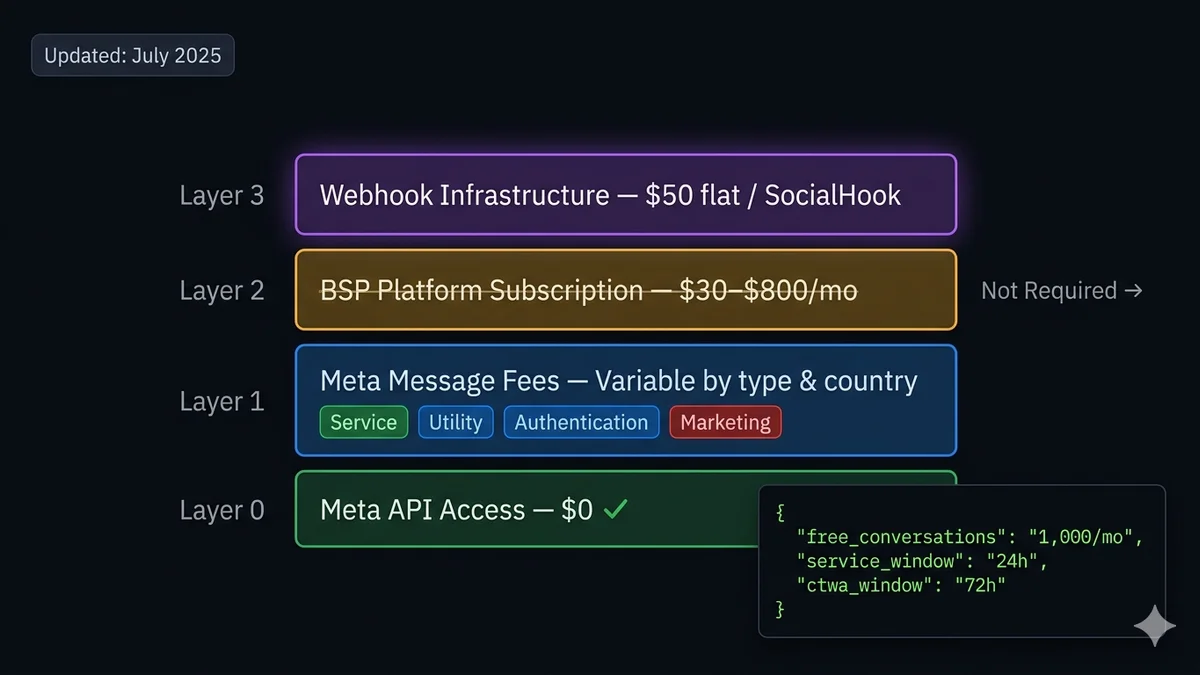
Every BSP pricing article presents WhatsApp API costs as a single blurry number. They are not. There are three completely separate cost layers, each billed by a different entity, each with different free zones. Understanding the separation is how you stop overpaying.
Layer 0
Meta API Access
Accessing the WhatsApp Cloud API itself. Creating your app, registering your number, generating your token. No Meta charge for this. The Cloud API is free to access.
$0
Layer 1
Meta Conversation / Message Fees
What Meta charges for outbound messages you send — marketing, utility, and authentication templates. Priced per-message since July 1, 2025. Inbound messages cost you nothing from Meta. Significant free zones exist (see below).
Variable by country & type
Layer 2
BSP / Platform Subscription
What a Business Solution Provider charges for their dashboard, chatbot builder, shared inbox, and managed onboarding. Ranges from $30 to $800+/month depending on the platform and contact volume. This is separate from Meta's fees. Optional if you build directly.
$30–$800+ per month
Layer 3
Webhook Infrastructure
The cost of receiving and processing inbound Cloud API events — your server, or a dedicated webhook platform like SocialHook. Exists regardless of whether you use a BSP. SocialHook replaces Layers 2 and 3 for inbound-only use cases at a flat rate with no per-message markup.
$50 flat SocialHook
The reason pricing feels opaque: BSPs quote Layer 1 + Layer 2 as a single blended cost. They never tell you that Layer 1 (what Meta charges) is the same regardless of which BSP you use — it goes directly to Meta. What differs between BSPs is purely Layer 2. If you go direct and use SocialHook as your webhook layer, you only pay Meta's Layer 1 fees plus SocialHook's flat Layer 3 fee. Layer 2 disappears entirely.
What Meta actually charges — the July 2025 update
On July 1, 2025, Meta shifted the WhatsApp Business API from a per-conversation pricing model to a per-message pricing model. This is the biggest pricing change since the API launched, and most articles still describe the old model.
Under the old model, Meta charged per 24-hour conversation window regardless of how many messages were exchanged inside it. Under the new model, Meta charges for each individual template message sent. The implications differ significantly depending on how you use the API:
High-volume broadcast operations (many short template messages) get slightly cheaper per-message charges on some categories
Conversational operations (long back-and-forth exchanges) that previously paid once per conversation may now pay more if they send multiple template messages within the same session
Inbound-heavy operations where customers initiate contact are largely unaffected — customer-initiated windows remain free
What Meta does not charge for: receiving inbound messages. When a customer sends your WhatsApp Business number a message, that event costs you nothing from Meta. The webhook fires to your endpoint at zero Meta cost. You pay your webhook infrastructure (Layer 3) — that's it.
The 4 message categories: free, cheap, and expensive
Every message on the WhatsApp Cloud API falls into one of four categories. The category determines what you pay. Rates vary by country — what follows is the structure, not country-specific rates, since Meta publishes these on their business pricing page and they change periodically.
Category
What it covers
Who initiates
Cost level
Free zone?
Service
Replies within the customer-opened 24-hour window
Customer-initiated
Lowest
First 1,000/month free
Utility
Order confirmations, shipping updates, appointment reminders, account alerts
The pattern is consistent: the more you initiate and the more promotional the message, the more you pay. The more you respond to customers who came to you, the less you pay — often nothing.
The 24-hour service window: the most valuable free zone
The service window is the mechanism that makes WhatsApp genuinely cost-effective for inbound-heavy operations. Here is exactly how it works:
When a customer sends a message to your WhatsApp Business number, Meta opens a 24-hour service window. During this window, every message you send back — text, image, document, interactive message, or rich media — falls into the Service category and costs nothing beyond the first 1,000 service conversations per month (covered below).
The window resets each time the customer sends a new message. So an active customer support conversation where the customer keeps responding extends the free window continuously. You only start paying Meta's fees when you initiate contact or the window expires and you follow up with a template message.
Free
24-Hour Service Window
Customer messages you first → a 24-hour free window opens. Every reply you send during this window is free (Service category, within the monthly quota). The window resets on every new customer message. Long active support conversations can stay in the free zone indefinitely as long as the customer keeps responding.
Customer-initiated onlyAll message types freeResets on each customer messageExpires 24h after last customer message
Free (72h)
Click-to-WhatsApp Conversation Window
When a customer initiates a conversation by clicking a Click-to-WhatsApp ad on Facebook or Instagram, or a Call-to-Action button on your Facebook Page, Meta opens a 72-hour free window — triple the standard service window. During this period, you can send any message type including marketing content without Meta's per-message charges. This is the largest free zone in the pricing model.
Ad-initiated conversations72 hours — not 24Marketing messages allowed freeRequires active Facebook/Instagram ad
Free quota
1,000 Free Service Conversations per Month
Every WhatsApp Business Account receives 1,000 free Service conversations per calendar month — regardless of account age, business size, or tier. Each conversation is the 24-hour window opened by a customer message. The first 1,000 of these per month have zero Meta charge. For small and mid-sized operations that primarily handle inbound customer service, this quota covers the majority of their activity at zero cost.
1,000 conversations/monthResets every calendar monthAll accounts — no application neededService category only — not marketing/utility
What "1,000 free service conversations" actually means for a support-focused business: If you handle 30 customer inquiries per day and each inquiry is a back-and-forth conversation where the customer keeps responding, you are consuming roughly 900 conversations per month. That is entirely within the free quota. Your Meta cost for inbound customer support at this volume is $0/month — not $30, not $50, literally zero. The cost is your webhook infrastructure to receive those inbound events.
The Layer you pay on top: platform and BSP fees
Here is where the confusion lives. Most businesses hear "WhatsApp API pricing" and assume they are hearing Meta's fees. They are usually hearing a BSP's blended price — Meta's Layer 1 fees plus the BSP's own Layer 2 subscription rolled together.
These are genuinely separate costs. Meta's fees go to Meta. Your BSP's fees go to the BSP. They are invoiced separately, negotiated separately, and can be changed independently. The implication: switching BSPs does not change what you pay Meta. And building directly on the Cloud API does not make you pay Meta differently.
What BSPs charge for in Layer 2:
Their shared team inbox and conversation management UI
No-code chatbot builder and flow designer
Campaign and broadcast management tools
CRM integrations (pre-built connections to HubSpot, Salesforce, etc.)
Analytics dashboards and reporting
Managed onboarding and Meta account setup support
If you are building your own logic — a custom AI agent, your own CRM integration, your own automation — you do not need a BSP's product stack. You need a webhook layer to receive inbound events and an access token to send outbound messages. The BSP's subscription (Layer 2) becomes an optional extra cost you are paying for features you never use.
What a developer-built inbound operation actually costs per month
Let's make this concrete. Here is the actual monthly cost breakdown for a business handling 900 inbound customer conversations per month, responding within the service window, and using SocialHook to receive webhook events — without any BSP subscription:
Example: 900 inbound service conversations/month
Meta API Access
Accessing the Cloud API, registering phone number, generating tokens
$0
Meta Service Conversations (900/month)
All within the 1,000 free monthly quota — customer-initiated, replied within 24h service window
$0
Meta Outbound Template Messages
Utility or marketing templates sent outside the service window (assumes 0 in this example — pure inbound operation)
$0–variable
BSP Platform Subscription
Not used — building custom logic directly on the API
$0
SocialHook Webhook Infrastructure
Receives all 900 inbound events, verifies HMAC signatures, normalizes payloads, forwards to your server. Covers WhatsApp, Facebook, and Instagram under one account.
$50 flat
Total monthly cost (inbound-only operation)$50 / month
Scale that same operation to 5,000 inbound conversations — beyond the 1,000 free quota but still all within service windows. Meta charges a low per-conversation rate for service conversations beyond the free quota (the exact rate varies by country — check Meta's Business Pricing page). SocialHook still costs $50 flat. No BSP subscription. No per-message markup from anyone. Your costs scale at Meta's official service conversation rate only.
Compare this to a BSP route for the same operation: Meta's service conversation fees plus $80–$300/month for a BSP subscription you use primarily as a webhook receiver. The BSP is charging Layer 2 fees for a product layer you are not actually using. SocialHook's Layer 3 fee — $50 flat — is all you need for the webhook delivery itself. See the full feature comparison at socialhook.io/en/pricing.
When a BSP subscription IS worth it: If your team is non-technical and needs a shared inbox UI, a no-code chatbot builder, and a campaign manager — pay for the BSP. Those are real features with real value. The mistake is paying a BSP's subscription when you are only using them as a webhook pass-through for a developer-built system. That is when SocialHook is the correct call. Our comparison with ManyChat and with Twilio break this down for the most common decision scenarios.
FAQ
Common questions
Is the WhatsApp Business API free?
Partially. Access to the Cloud API is free from Meta. You get 1,000 free service conversations per month for customer-initiated conversations where you reply within the 24-hour service window. Beyond that quota, Meta charges per service conversation at a low rate. Outbound template messages (marketing, utility, authentication) are charged per-message since July 1, 2025. Separately, you pay your platform or webhook infrastructure provider — this is not a Meta fee.
What is the 24-hour service window and why does it matter for costs?
When a customer messages your WhatsApp Business number, Meta opens a 24-hour free reply window. Every message you send during this window is in the Service category — the cheapest category, and free for the first 1,000 per month. If your operation is primarily inbound (customers contact you), you can run a significant volume of WhatsApp customer service entirely within these free windows. The window resets whenever the customer sends a new message, so active conversations stay free indefinitely.
What changed with the July 1, 2025 pricing update?
Meta shifted from per-conversation to per-message pricing for outbound templates. Previously, all messages inside a 24-hour conversation window cost one conversation fee. Now, each individual marketing, utility, or authentication template message you send is charged separately. Service messages (replies within the customer window) remain free within the monthly quota. Inbound messages remain free regardless.
Does receiving inbound WhatsApp messages cost anything?
Nothing from Meta. Inbound messages are free to receive — Meta does not charge you when a customer messages your number. The only cost for inbound is your webhook infrastructure: the server or platform that receives and processes the event. SocialHook handles this for $50/month flat, with no per-message charge and no Meta markup, covering unlimited inbound volume across WhatsApp, Facebook Messenger, and Instagram DMs.
What is SocialHook's $50/month — is it a Meta fee?
No. SocialHook's $50/month is the webhook infrastructure fee (Layer 3 in our cost model). It covers receiving every inbound Cloud API event, HMAC-SHA256 signature verification, payload normalization, automatic retry on failure, and full delivery logs — delivered to your server or workflow tool in under 50ms. It is entirely separate from what you pay Meta. SocialHook has zero markup on Meta's conversation fees. You pay Meta directly at their published rates; you pay SocialHook $50 flat for the infrastructure layer.
How does the Click-to-WhatsApp 72-hour free window work?
When a customer starts a conversation by clicking a Click-to-WhatsApp ad on Facebook or Instagram, Meta opens a 72-hour free conversation window — three times the standard service window. During this period, any message you send — including marketing-category content like promotions — is free. This makes Click-to-WhatsApp ads an extremely cost-efficient inbound channel: you pay for the ad click (Facebook/Instagram ad cost), but the WhatsApp follow-up conversation is free for 72 hours.
When does the WhatsApp API become expensive?
When you are sending high volumes of outbound marketing messages to opted-in contacts outside of any free window. Marketing category messages carry the highest per-message rate and there is no monthly free quota for them. If you are running large broadcast campaigns — tens of thousands of marketing messages per month — your Meta fees scale proportionally. At that point, the comparison to switch from email marketing (near-zero per-message cost) to WhatsApp marketing (non-trivial per-message cost) needs to be justified by conversion rate uplift.
$50/month for inbound. $0 from Meta if you stay in the window.
Connect your WhatsApp number to SocialHook and receive every inbound message as clean JSON in under 50ms. Your Meta service conversations cost nothing within the free quota. We charge a flat $50 — no conversation markup, no per-message fee, no contacts-based tiers.