
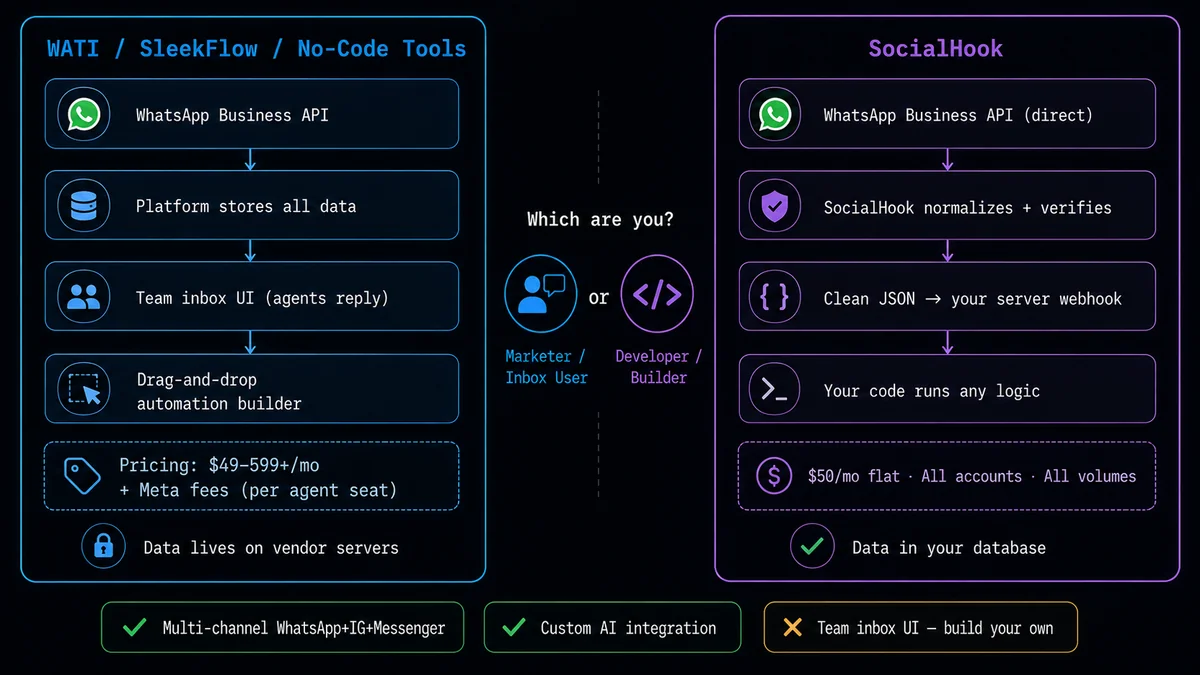
SocialHook vs WATI and no-code WhatsApp tools — two-lane architecture diagram, per-seat pricing vs flat webhook cost, developer control vs marketer UI
In this comparison: What WATI and no-code tools actually are · What SocialHook actually is · Why they're fundamentally different products · Cost math: per-seat vs flat rate · Data ownership and lock-in · Custom logic limits · The agency and SaaS case · Decision matrix

What each product actually is

WATI, SleekFlow, ManyChat for WhatsApp, Respond.io, Pushwoosh WhatsApp — these are all variations of the same product category: a SaaS platform that connects to the WhatsApp Business API and provides a team inbox, drag-and-drop automation builder, contact list management, and broadcast campaign tools. They are designed for marketing managers, customer support teams, and operations staff. You sign in via a web browser, drag flows together, add contacts, and send campaigns. No code required.

SocialHook is a webhook normalization layer. It receives inbound WhatsApp messages (and Instagram DMs and Facebook Messenger), verifies their authenticity, normalizes them to a consistent JSON format, and delivers them to your server endpoint. Your code then processes those events however your business logic requires. There is no web inbox, no drag-and-drop builder, no contact list. SocialHook is infrastructure — a pipe that gets clean data to your code in real time.

These are not competing products in the traditional sense. They solve different problems for different people. The mistake is choosing based on marketing comparison pages written by vendors who have a financial interest in being preferred.

The architectural difference

WATI / SleekFlow / No-Code Tools
The SaaS platform model
WhatsApp Business API
WATI's servers receive and store all messages
WATI's inbox UI → your agents respond manually
WATI's automation engine runs drag-and-drop flows
WATI's API → your code (limited, constrained)
SocialHook
The webhook infrastructure model
WhatsApp Business API (direct Cloud API)
SocialHook verifies, normalizes, stores media
Clean JSON → your server endpoint in real-time
Your code runs whatever logic you build
Your code → WhatsApp Cloud API for replies

The structural consequence: with WATI, your data lives in WATI's database. Your automation logic lives in WATI's builder. Your conversation history is accessible through WATI's API on their terms. With SocialHook, your data goes directly into your database. Your automation logic is code you control. Your conversation history is a schema you design.

Cost math: per-seat vs flat rate

No-code WhatsApp platforms charge per agent seat — the number of people who need access to the inbox. This makes them economical for small teams and expensive for large teams or high-conversation-volume products. SocialHook charges a flat $50/month regardless of agents or volume.

Scenario WATI approx. cost SocialHook cost Who wins
1 agent, 200 convos/mo ~$49/mo (starter plan) $50/mo + Meta fees ~Equal
3 agents, 1K convos/mo ~$79–99/mo + Meta fees $50/mo + Meta fees SocialHook wins
8 agents, 5K convos/mo ~$199–299/mo + Meta fees $50/mo + Meta fees SocialHook saves ~$150–250/mo
15 agents, 20K convos/mo ~$399–599/mo + Meta fees $50/mo + Meta fees SocialHook saves ~$350–550/mo
SaaS/product, 100K convos/mo Enterprise pricing ($1K+/mo) $50/mo + Meta fees SocialHook saves $1K+/mo
Agency, 10 client accounts $499+/mo (multi-account plans) $50/mo (all accounts) SocialHook saves $450+/mo
The agent count vs volume distinction matters: No-code platforms primarily charge per agent seat, not per conversation. If you have 50,000 conversations per month handled by 3 agents (with heavy automation), you pay the 3-agent rate on WATI. If you have 500 conversations per month spread across 20 agents, you pay the 20-agent rate. SocialHook's $50/month is indifferent to both dimensions — no agents, no conversation volume cap.

Data ownership and lock-in

This is the strategic question most businesses don't ask until it's too late. When you run your WhatsApp customer conversations through WATI or SleekFlow:

  • All customer conversation history is in their database. When you switch platforms — and most businesses do eventually — exporting complete conversation history is difficult or impossible depending on the vendor.
  • Your contact list is in their system. The WhatsApp opt-in relationships your business has built live in the vendor's infrastructure. Migrating contacts to a new platform requires rebuilding or re-importing, often losing metadata.
  • Your automation logic is in their builder. The flows you've built in WATI's drag-and-drop editor have no portable format. Rebuilding them in a new system or in code is weeks of work.
  • Their API terms govern your data access. You can access your data through their API on their schedule, with their rate limits, according to their terms which can change.

With SocialHook: your data goes to your database from the first message. Your schema. Your queries. Your backup policy. Your portability. Switching away from SocialHook — which we obviously hope you won't — means redirecting your WhatsApp Cloud API webhook to a different URL. Your data stays exactly where it is.

Custom logic: where no-code tools hit a wall

No-code platforms are sufficient for a fixed set of use cases: keyword-triggered replies, FAQ auto-responses, form-based lead capture, template broadcast campaigns. They hit a wall when you need:

  • Real-time database lookups. "Reply with this customer's order status" requires a database query, not a static template. WATI's automation builder can call webhooks, but you're building the backend anyway — at which point the WATI layer adds cost without adding capability.
  • Multi-step conversation state. A conversation that collects a name, then an order number, then verifies it against your system, then routes based on order status — this requires real state management, not a linear flow builder.
  • AI-powered responses. GPT-4o with your product catalog, your return policy, your live inventory as context — this requires code that runs against your systems. No drag-and-drop builder can configure the context, the routing logic, or the fallback behavior at the level of sophistication that drives real deflection rates.
  • Custom business rules. "If the customer's account tier is Gold AND they haven't ordered in 30 days AND the DM arrives between 9am–5pm EST, route to the premium support queue and notify the account manager via Slack." This is code. It cannot be expressed in a visual flow builder.

SocialHook's architecture removes this ceiling. Every event arrives at your server. Your code runs arbitrary business logic — database queries, AI integrations, third-party API calls, conditional routing across multiple systems. The complexity ceiling is your infrastructure, not the vendor's feature set.

Feature comparison: what each genuinely does

WATI / SleekFlow / No-Code Tools
Strong at these use cases:
Shared team inbox — multiple agents handling customer DMs
Simple keyword-triggered auto-replies
Broadcast campaign to opt-in contact lists
Pre-approved template management UI
Agent assignment and SLA tracking
CSAT surveys and basic analytics
Custom database queries in automation — limited
Multi-step stateful conversations — constrained
Data ownership — stored in vendor DB
Unlimited AI integration depth — limited
SocialHook
Built for these use cases:
Real-time WhatsApp events to your server — normalized JSON
WhatsApp + Instagram + Messenger in one $50/month
Custom automation logic — any code, any system, any AI
Full data ownership — your database, your schema
Multi-account agency or SaaS setup — one endpoint
HMAC-verified delivery — security without boilerplate
Flat pricing regardless of team size or volume
Agent inbox UI — not available (use your own or open-source)
Broadcast campaign tools — not available
No-code flow builder — not available

The agency and SaaS case: where SocialHook wins decisively

If you manage WhatsApp for multiple clients (agency) or you're building a product where each customer has their own WhatsApp number (SaaS), the math changes dramatically. No-code platforms either don't support multi-account cleanly, charge enterprise rates for it, or create architectural friction between client accounts.

SocialHook handles multi-account routing natively: every WhatsApp number connects to your single SocialHook workspace. Events from different accounts arrive at your webhook endpoint differentiated by the account identifier field. You route them with a database lookup — one table, one line of code. The $50/month covers all accounts regardless of how many you add.

The multi-channel advantage at $50/month: If your clients or product also need Instagram DMs and Facebook Messenger alongside WhatsApp, SocialHook delivers all three channels in the same normalized format to the same webhook endpoint. The cost is still $50/month. WATI's multi-channel support typically comes at higher plan tiers. The developer who built their WhatsApp handler already has Instagram and Messenger working for free because the handler is identical — just the platform field differs.

Decision matrix: match your reality to the right tool

Who you are
Your situation
Use this
Marketing manager
Non-technical. Need to send WhatsApp campaigns, manage contacts, reply to customers. No developer on the team. Need something working this week.
WATI / SleekFlow
Support team lead
Team of 3–8 agents handling inbound WhatsApp support tickets. Need assignment, SLA tracking, CSAT. Some technical capacity but no backend developer.
WATI / SleekFlow
Developer / CTO
Building a WhatsApp chatbot, e-commerce automation, or support bot. Need real-time events, custom logic, database integration, full data control.
SocialHook
SaaS product builder
Building a product where each customer gets their own WhatsApp number. Need multi-account routing, normalized events, flat pricing that doesn't scale per customer.
SocialHook
Marketing agency
Managing WhatsApp for 5–20 client accounts. Clients want custom automation. Per-account SaaS pricing is getting expensive. Need developer-grade control.
SocialHook
E-commerce brand (technical team)
Need order tracking in DMs (Shopify lookup), GPT-4o product recommendations, story reply automation. Have a developer. Standard tools can't do custom Shopify integration.
SocialHook
Hybrid team
Need a team inbox for agents (WATI/Chatwoot) AND custom automation logic (SocialHook). Agents handle escalations; code handles FAQ and automation.
Both (hybrid)

Common questions

What is the difference between WATI and SocialHook?
WATI is a no-code SaaS platform — it gives marketing and support teams a web inbox, drag-and-drop automation builder, contact lists, and campaign tools. SocialHook is developer infrastructure — it receives WhatsApp webhook events and delivers them as normalized JSON to your server for your code to process. WATI stores your data; SocialHook routes events to your data. They serve different people solving different problems.
Can I use SocialHook and WATI together?
Not on the same WhatsApp number — each WhatsApp number can only have one webhook endpoint registered. However, you can run a hybrid setup: SocialHook for your developer-built automation (handling common questions, AI replies) and a separate agent inbox tool like Chatwoot or Crisp for human escalations, with SocialHook routing escalated conversations to the inbox. This is the recommended hybrid architecture for teams that need both automation and human agents.
Is WATI cheaper than building with the WhatsApp API directly?
For very small teams (1–3 agents) with low conversation volume and no developer resources, WATI's $49–99/month starter pricing can be cheaper than the development cost of building your own system. For larger teams, high volume, or product builders, the calculation reverses. WATI's per-seat pricing scales to $200–600+/month for larger teams. SocialHook's $50/month covers any number of agents, any conversation volume, and three channels (WhatsApp + Instagram + Messenger).
What happens to my data when I switch from WATI to a direct API setup?
WATI stores all your conversation history, contacts, and automation flows in their database. When you switch to a direct API setup, you will need to export contacts (WATI provides CSV export), and rebuild automation logic in code. Historical conversation history may be partially exportable via WATI's API but is often limited in scope. This is the primary switching cost — one reason to consider starting with a direct API approach if you anticipate building custom logic in the future.
Does SocialHook have a team inbox for WhatsApp?
No — SocialHook is a webhook infrastructure layer with no inbox UI. If you need a team inbox alongside SocialHook's normalized events, the recommended open-source option is Chatwoot (self-hosted, free). Commercial options include Crisp, Freshdesk, or Intercom. The hybrid architecture uses SocialHook for automated handling and routes only escalated conversations to the agent inbox tool — significantly reducing the number of agents (and seats) needed.

Raw events. Clean JSON.
Your data, your logic.

If you've outgrown no-code WhatsApp tools — or you're a developer who never wanted them — SocialHook delivers every WhatsApp, Instagram, and Facebook Messenger event to your server, normalized and verified. You write the business logic. We handle the webhook infrastructure. $50/month covers all three channels.

No credit card required · $50/month after trial · WhatsApp + Instagram + Messenger